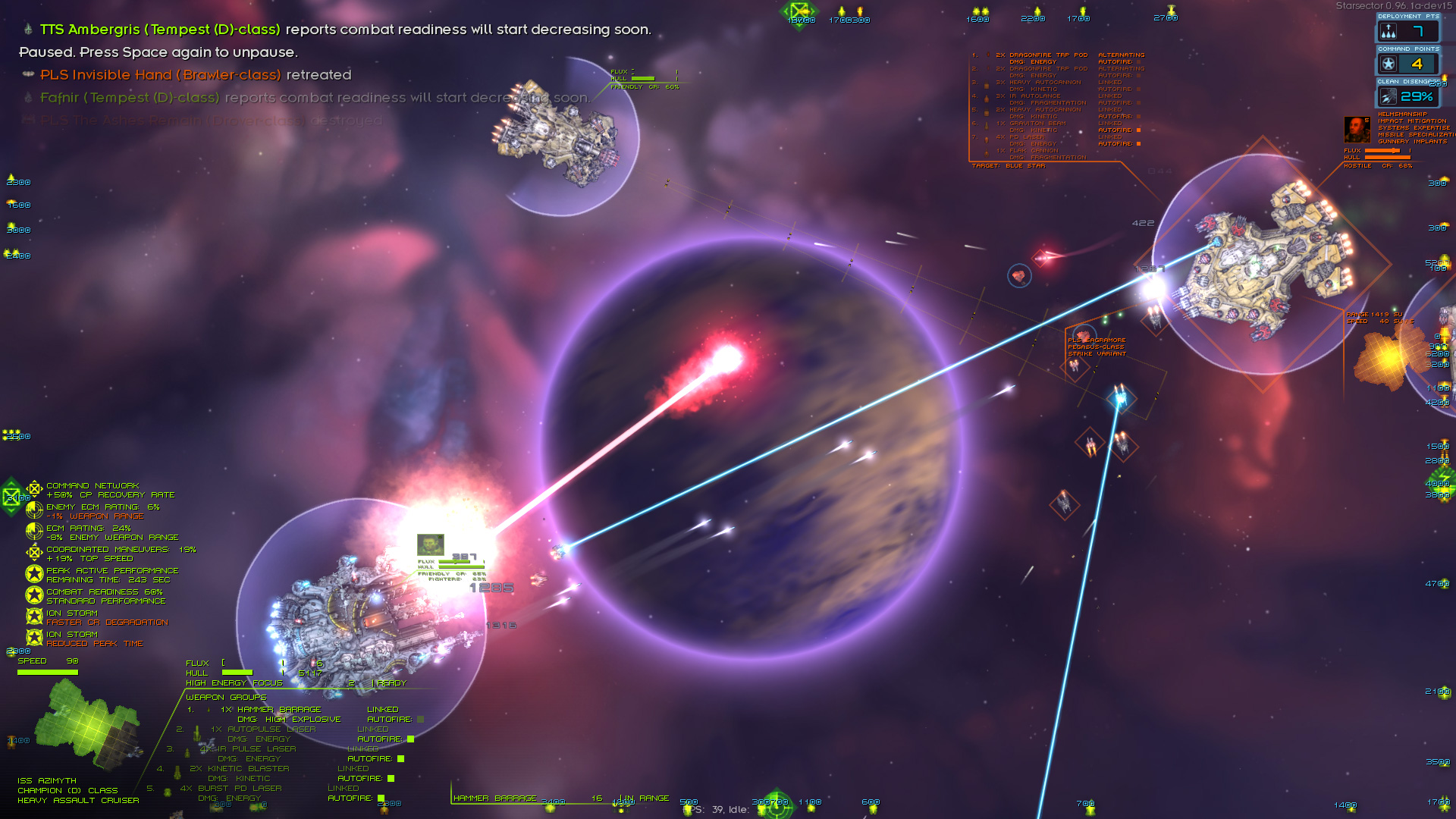
It’s been a bit quiet so I figured I could show some of the in-progress illustration work I’m doing for Starsector to flesh out the world of the game and events therein.
So let’s have a look through my illustrations folder, shall we? Do note that most of these are very much in-progress, though of course I’m not going to show you any of the truly failed compositions. Still, I do hope you find it interesting to get a glimpse into my process here.
“Put it in Bay 12 and be careful – those uranium rounds are hot!”
Now these illustrations are intended to be shown in-game as an accompaniment or decoration rather than used as promo art so they’re much smaller than earlier work I’ve shown on the blog here. This has the added advantage of making the process of creating them much faster than full-sized drawings. It’s more interesting for me, too, because I can experiment more with theme, composition, and technique.
Part one is here. If you haven’t read it, it provides context for what I’m going to talk about here.
Travel Drive Conceptually, ships use a different, much faster means of transportation for travel than they do for battle. Presumably, they either have to pop out of it every so often to navigate, or are forced to slow down by targeted nav system interference/debris fired across the projected trajectory/need to divert engine power to defensive systems due to the threat of enemy fire/<insert your favorite technobabble here>. Personally, I’m in favor of it being some kind of nav interference, whether it’s due to hypervelocity debris or jamming. The point is, a fleet can be forced to slow down and engage in battle.
On the flip side, a fleet disengaging from battle means that they’ve been able to re-engage their travel drives and put on speed. Maybe the nav computers finally calculated a safe trajectory. Maybe enough distance has been gained to eliminate the threat of enemy fire. The concept was always there, even if it wasn’t directly explored in the gameplay.
But now, there’s an opportunity to use it to improve the experience. With that in mind, the new mechanics:
A ship or fighter wing being deployed into combat comes in with travel drive on, and it remains on for about 5-6 seconds – enough time to move around 3 grid squares in the command screen
A retreating ship or fighter wing engages travel drive when it gets to within a couple grid squares from the border it’s heading for to make its getaway
A Medusa and a Wolf entering battle with Travel Drive (possibly pending cooler name) on.
This does a couple of things, all of them to do with reducing the impact of borders on gameplay. One, maps can be bigger without battles taking too long to heat up, because the extra space around the border is traversed very quickly using travel drive. This extra padding means objectives – which fighting often centers around – can be much farther away from borders. Two, retreating ships separate from pursuit far away from the border, almost entirely eliminating the “chase ship all the way to a border” situation. Read the rest of this entry »
In a previous post, I talked about combat readiness (“CR”) as a means of tying the campaign and combat layers closer together, but also as a means of cleaning up existing mechanics. The mechanics surrounding battle are a perfect candidate, both because they need cleaning up, and because they wouldn’t work well with CR as they now stand. Changes to these aren’t just a consequence of adding CR; rather, they’re part of that process.
First, a quick recap of how things work now. When the player encounters another fleet, they can choose to attack them or leave. If either side wants to attack, the fleets engage, and each side has three options: “attack”, “defend”, and “escape”. Without going into too much detail, there’s a rock-paper-scissors mechanic there where attack beats escape beats defend beats attack. (“Escape” beating “defend” simply means a clean getaway, with “beating” in general meaning having an advantage in the battle, not automatic victory.)
Playing rock-paper-scissors vs the computer isn’t fun. The computer is either predictable or random, but in either case you don’t get the mind games that make it interesting vs a human opponent. The “escape” mechanic also doesn’t work well. The escapee has to run their ships across the map and retreat them off the enemy side, which is much more difficult than “attacking” and then retreating ships off their side of the map – which they could do without seeing a single enemy. If they do that, their ships take some automatic, random post battle damage to simulate a chase after this retreat, but that’s a problem in itself. Either it does enough damage so that retreat from a real lost battle is disastrous, or it doesn’t do enough damage to stop “attack to retreat” being viable.
Adding in CR, the current setup is also open to being gamed. For example, a single Hound-class frigate fighting against an Onslaught-class battleship – the Hound could engage, then immediately retreat, causing a CR loss for both ships for being deployed in battle. However, the Hound both costs less CR to deploy and recovers it faster. So, it could reliably beat an Onslaught without firing a single shot but wearing down its CR. Read the rest of this entry »
In this post, I’m going to talk about one of the new mechanics we’ve been working on; but first, a little background. Starsector has been designed starting with the combat layer and working up, and this has both up and downsides. We get to work out the combat layer first, and make reasonably polished releases with combat as the centerpiece – that’s a good thing. On the other hand, this means that as the campaign comes into focus, we can either 1) force it to fit in with how combat currently works or 2) adjust the way combat works to make it a better fit for how we want the campaign to work.
Option one is unquestionably faster and easier, but also seems likely to result in a tacked-on campaign because of the compromises that we’d have to accept to make it fit. Option two is more work, but is the one most likely to result in a campaign that’s a game in its own right, on par with combat. Do I even need to say which option I find more appealing? (Hint: it’s the second one.)
Enter combat readiness (“CR” henceforth), a mechanic specifically intended to improve the connection between the campaign and combat layers. There are already mechanics that link the two – for example, the persistent fleet, ship damage & repairs between battles, and character skills. So, we’re not talking about anything radically new; just taking stock of what’s there and cleaning it up, smoothing over the rough edges. While this involves some changes to combat mechanics, the goal is to enable the campaign to exert a greater influence on combat (and vice-versa), rather than to rework combat for its own sake. We’re giving the campaign tools to work with, levels to push, knobs to turn, analogies to abuse.
Conceptually, CR represents weapon and system maintenance and repair, securing the magazines, making sure there are no cargo crates knocking about in the hold, that sort of thing. In-game, it’s presented as a percentage. A good way to think of it is as a “stamina” mechanic on the campaign level.